


๐ธ Capture brilliance, frame your legacy.
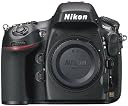
The Nikon D800 is a professional-grade DSLR featuring a 36.3MP full-frame CMOS sensor, 51-point autofocus system, and 6 fps continuous shooting speed. Designed for photographers and multimedia pros, it delivers exceptional image quality with broad dynamic range and true-to-life colors. It supports Full HD 1080p video recording, offers versatile connectivity via USB and Mini HDMI, and is compatible with Nikon F-mount lenses. This camera body-only model is perfect for those demanding superior performance and precision in both stills and video.
| ASIN | B0076AYNXM |
| Age Range Description | Adult |
| Aperture modes | Yes |
| Are Batteries Included | Yes |
| Aspect Ratio | 1.30:1 |
| Aspect ratio | 1.30:1 |
| Auto Focus Technology | Continuous, Face Detection, Live View, Multi-area, Phase Detection, Selective single-point, Single, Tracking |
| Autofocus | Yes |
| Autofocus Points | 51 |
| Brand | Nikon |
| Built-In Media | Battery, Body Cap, Instruction Manual, USB Cable |
| Camera Flash | Hotshoe |
| Camera Lens | Telephoto lens with a focal length range up to 300mm, offering long-range shooting capabilities. |
| Color | Black |
| Compatible Devices | Nikon F (FX) mount devices |
| Compatible Flash Memory Type | CF Type I |
| Compatible Mountings | Nikon F (FX) |
| Compatible mountings | Nikon F (FX) |
| Connectivity Technology | HDMI, USB |
| Continuous Shooting | 6 |
| Crop Mode | 1.30:1 |
| Customer Reviews | 4.4 out of 5 stars 422 Reviews |
| Digital-Still | Yes |
| Display Fixture Type | Fixed |
| Display Resolution Maximum | 921,000 |
| Display Type | LCD |
| Dots Per Screen | 300 |
| Effective Still Resolution | 36.3 MP |
| Expanded ISO Minimum | 100 |
| Exposure Control | Aperture priority (A), Automatic, Manual, Shutter-priority (S) |
| File Format | NEF (RAW): 12 or 14 bit, lossless compressed, compressed or uncompressed, TIFF (RGB), JPEG |
| Flash Memory Bus Interface Type | PATA, SDIO/SDHC |
| Flash Memory Type | Compact Flash (Type I), SD/SDHC/SDXC UHS-I compliant |
| Flash Memory UHS Speed Class | UHS-I |
| Flash Memory Video Speed Class | V30 |
| Flash Modes | Auto, On, Off, Slow Synch, Rear Curtain Synch, Front-curtain Sync, Red-eye reduction, Slow sync, Slow rear-curtain sync, Fill flash |
| Flash Sync Speed | 1/250_sec |
| Focal Length Description | 300 millimeters |
| Focus Features | Multi-CAM3500 FX Phase detection with 3D tracking |
| Focus Mode | Manual Focus (MF) |
| Focus Type | Manual and Autofocus |
| Form Factor | Mid-size SLR |
| Global Trade Identification Number | 04960759134653 |
| HDMI Type | Type C Mini HDMI |
| Hardware Interface | USB |
| Has Color Screen | Yes |
| Image Capture Type | Stills & Video |
| Image stabilisation | Digital, Dynamic, Optical |
| Image stabilization | Digital, Dynamic, Optical |
| Item Weight | 1 Grams |
| JPEG Quality Level | Fine |
| Lens Type | Nikon F-mount |
| Manufacturer | Nikon |
| Manufacturer Part Number | 25480 |
| Maximum Aperture | 3.5 Millimeters |
| Maximum Focal Length | 300 Millimeters |
| Maximum Image Size | 6.3 Inches |
| Maximum Shutter Speed | 1/8000 Seconds |
| Maximum focal length | 300 Millimeters |
| Memory Slots Available | 1 CompactFlashยฉ (CF) card and 1 Secure Digital (SD) card |
| Memory Storage Capacity | 4 GB |
| Metering Methods | Multi, Center-weighted, Average, Spot |
| Minimum Focal Length | 55 Millimeters |
| Minimum Shutter Speed | 30 seconds |
| Model Name | Nikon D800 |
| Model Number | 25480 |
| Model Series | D800 |
| Movie Mode | Yes |
| Night vision | No |
| Number of Diaphragm Blades | 7 |
| Number of Items | 1 |
| Number of Packs | 1 |
| Optical Zoom | 1 x |
| Photo Sensor Resolution | 16 MP |
| Photo Sensor Size | 35.9 x 24.0mm |
| Photo sensor technology | CMOS |
| Real Angle Of View | 0.39 Degrees |
| Recording Capacity | 6 Minutes |
| Remote Included | No |
| Screen Size | 3.2 Inches |
| Self Timer | 10 Seconds |
| Sensor Type | CMOS |
| Series Number | 25480 |
| Shooting Modes | Automatic, Manual, Movie, Program |
| Skill Level | Professional |
| Special Feature | 921,000-dot TFT-LCD with 170ยฐ wide-angle viewing |
| Specific Uses For Product | Photography |
| Supported Image Format | NEF (RAW), TIFF (RGB), JPEG, NEF (RAW)+JPEG |
| Supported file format | NEF (RAW): 12 or 14 bit, lossless compressed, compressed or uncompressed, TIFF (RGB), JPEG |
| Total Still Resolution | 36.3 MP |
| Total USB 3.0 Ports | 1 |
| Total USB Ports | 1 |
| Total Video Out Ports | 1 |
| UPC | 018208922062 018208254804 |
| Unit Count | 1 Count |
| Video Output | HDMI |
| Video Resolution | FHD 1080p |
| Viewfinder | Optical |
| Viewfinder Magnification | 0.8x |
| White Balance Settings | Auto |
| Write Speed | 6 fps |
| Zoom | manual |
D**U
Wonderful
Wonderful
K**D
Great camera! Please do not pixel peep
Let me first state that this camera will not make you a better photographer. Not even close. It may even make you a worse photographer. Why? because the hand shaking that was forgivable before will now be more evident at 100% zoom. Wait, why are you pixel peeping a 36MP camera? For pixel peepers, avoid this camera at all cost! I'll explain more below. The beauty of a high megapixel camera is that it makes your pictures better at the same megapixel size as your last camera! Let me explain this, for most lens, sharpness differences can be viewed at 100% zoom. Unless you print at gigantic 36MP, which only a very small percentage of pros will be using, it's moot. Now, when you downsize a picture, the pixels are interpolated. Lens that were previously unacceptable at 12MP all of a sudden look pretty decent at 12MP downsized from 36MP! For example, a picture that was taken with slight motion blur at 100% pixel peep will disappear when I re-size it to 12MP. That's the thing, most will not print a 36MP picture at 36MP! You will have to resize it to make prints! It's pretty insane to upload 36MP JPEGS to make 4x6 prints anyway. Although someday, I will hang a 36MP picture on my wall. So what's the purpose of getting a 36MP? First, high ISO noise will be interpolated out of existence when downsized. Second, blurriness will be sharpened out of existence when downsized. Third, your not so sharp lens at 100% will look pretty darn good downsized. You need to compare the pictures produced at the printed size and not at 100% zoom! If you take a picture of your face and zoom in at 100%, it'll be pretty unflattering with all the pores and stuff. Same concept here. So if you buy this camera just to view pictures at 100% zoom, you will all be disappointed because that simply is not the point. Coming from a D90, these are the things that are better. 1. Full frame. Your 50mm prime now has a real 50mm FOV rather than a fake 75mm FOV. 2. Bokeh. You get to see more of that 50mm FOV which means the bokeliciousness that were lost on the D90 is now there. The further you go away from the focus point, the softer the bokeh is. When the DX picture is truncated, you lose that bokeh. This is why full frame appears to have better bokeh. 3. ISO. When downsized, my ISO 6400 looks like ISO 100 on a 12MP. Maybe I'm exaggerating a little...but not by much. 4. Sharper image with the same lens. Yes, at 100% zoom, all the short-comings are there to see. At 12MP downsized, it will look very great. 5. Cliff Mautner looking pictures. Yes, I went there. I've always looked at those nice midday pictures where Cliff take pictures of his models in front of a green background (trees) and the model's faces has that cool looking rim lights... yeah, I can replicate that! Except his models are better looking. Is this due to the better sensor or the better imaging processor? 6. Better dynamic range. When the sun's beating down on you at high noon, dial the exposure compensation down -2EV, shoot without flash, and then fix the under exposed parts without blowing out highlights. Tada, natural light at high noon without flash! Very nice, Nikon! I have no green cast. I have no out of focus focus points (that I know of). My beep on focus function is broken. I turn it on, but it doesn't beep. I don't know why. At 100% zoom, my prime doesn't look that sharp at F1.8 as it does at F4. But I don't care. If you want a camera to test out lens sharpness, this camera is it! But don't blame me if you proceed to throw them all in the trash to buy sharper lens. Is this a better camera than the D700? It depends. Is it worth the $1300 premium for the added functionality? Is a $3000 Channel purse worth $1300 more than a $1800 LV purse? A purse doesn't even take pictures and you sure as heck can't downsize it on command! And yet my wife buys a new one each year. For me, yes it's worth it! I'm referring to the camera, not the purse. Then again, if you were reading carefully, I previously own a D90 not a D700. As a final note, I'm going to read more books on photography because this camera tells me what I'm terrible at it. I look at the pictures on Flickr that people took using this camera, then I compare it with my pictures, all I want to do is to punch myself in the face. If I become a better photographer as a result of owning this camera, then I guess the $3000 is worth it. This is the Internet. Feel free to tell me I'm idiot and that I'm wrong in the comments. Update 6/23/12: (1) The beep issue was resolved by deleting bank A and then use bank B. Unfortunately, my camera has the left focus issue. Most of my lens are fine, however I borrowed a friend's 24-70mm and the left most focus definitely has a problem on this one. In liveview, it works fine. I'm going to wait a few months to see what Nikon says about this before sending it in for repair.
A**A
It's great camera - the image quality is superb
It's great camera - the image quality is superb. However, and you'll find this in other reviews also - the LCD screen has a weird yellowish-green tint to it and the shutter is super loud. That said, the images come out fine (no tint). It's a good pro-level camera.
C**D
Nikon's D800 Is The New Legend
Nikon's D800 will go down in history as one of their best dslrs ever made. The D700 used to be go to classic. It was the first affordable FF DSLR from Nikon to incorporate a full frame digital sensor (a year after the D3), but it's title as a classic will fall to the D800. In almost every single aspect the D800 is a better camera than the D700 ever was. The D810 did little to improve the overall experience of the D800. When you use both cameras as I have you see the disparity between marketing claims in real life performance. All of the claims for a more balanced shutter and less vibration of the D810 did little to mitigate or improve the outcome. When you add in the fact that the D810 is a camera that doesn't quite handle as well as the D800 nor sound as good, for example by removing the rotating metering dial around the AEL lock button, and quieting the shutter sound, the D810 is no longer really much better at all. The slightly faster frame rate does not bring it into the category of being a good sports or action camera therefore the specification itself is a bit useless. The D800 will shoot up to 6FPS with an attached grip using the 1.2x and DX crop modes, 5fps without the grip. In order to really jump up in any performance overall you have to purchase the D850. That camera right now is about four times as expensive as the D800 used. The resolution advantage if you want to call it that, is very much minimal at best, at least for most practical circumstances. Nikon's D850 has also turned out to not be that good of a sole performer for action and sports (D series are MUCH better) again making you question what you're really getting for all that extra money. In the real world not much, although admittedly the D850 looks like a much better camera on paper and you're never going to convince a D850 owner to the contrary. Understandable, of course. Working photographers such as myself know that we do not live by marketing claims or by paper specifications. We live by judging a camera's performance in real time in real life circumstances. I've owned or used extensively all three of the 800 series cameras from Nikon, and I can tell you that the D850 is really not much of an upgrade from previous iterations practically speaking. I own several bodies in multiple camera formats because I like to use a camera that works best for a particular type of photography. The 800 series cameras work best for everything except action work. There are other cameras such as the D series pro level cameras and the D500 that are better suited to this type of work. I see many photographers trying to buy one camera body to do everything well, in the end they only end up disappointed because their camera will not live up to all the unrealistic expectations that a marketing department or specifications of the camera would have you believe they could fulfill. Real life is everything, unless you just want to collect cameras that collect dust and compare their mathematical specifications in la la land. From a working photographer's perspective though, the D800 is a fantastic classic legendary camera, and may go down as Nikon's best full frame camera for the dollar of all time. That is why I think it will dethrone the legendary D700 here in the near future. The bang for the buck is amazing. This is not to say that other cameras cannot perform better in certain aspects of performance, that is not my claim at all. The claim I make is that there is a loss on your return of investment when you purchase its successor cameras. The value proposition of the D800 is much higher and the performance is at least 90 to 95% as good as its successors. Marketing departments and shills dominate most of the airwaves online and in writing, this unfortunately is bolstered by forum "heroes" that defend their brands and purchases. That is not the world that a professional photographer lives in. Not at all. Therefore my opinion is going to be soundly different than the majority you may read out there. I'm perfectly happy with this fact because I know in the end most people will end up coming to the same conclusion eventually, if and when they become working photographers. The newer mirrorless cameras still do not focus as well as dslrs in critical circumstances for action sequences, and they probably won't ever surpass, but may catch up, to DSLR performance in this respect. Camera companies want you to buy their latest cameras so they do not go out of business. Of course that is very understandable but that doesn't mean that their promises through their marketing departments will live up to your expectations as a photographer. If you would rather listen to wisdom and save a lot of money, then this review is for you. The D800 is a reliable tank of a camera that is pleasurable to use, consistent, durable enough for generations of ownership, and priced in the used market for an extraordinarily great deal. It's image quality is some of the best that has ever been. Take some advice from a working photographer who has used nearly every DSLR or high-end mirrorless camera offered by almost every manufacturer.
P**E
Defective
I purchased this camera and loved the quality however it has a common problem amongst D800s. It makes a ratchet sound continuously when initiating the zoom on the lens. This is a camera issue known to Nikon. Amazon was fantastic in dealing with my issue as they always are.....however the seller probably knew about this, which makes me very angry as I purchased an expensive lens to accompany the camera.
Trustpilot
1 week ago
2 weeks ago